Successful marketing is not just about selling a product or service—it is about delivering value to customers through a well-planned strategy.
The 7Ps of the marketing mix is an approach that helps businesses craft effective marketing strategies by considering factors that influence consumer decisions.
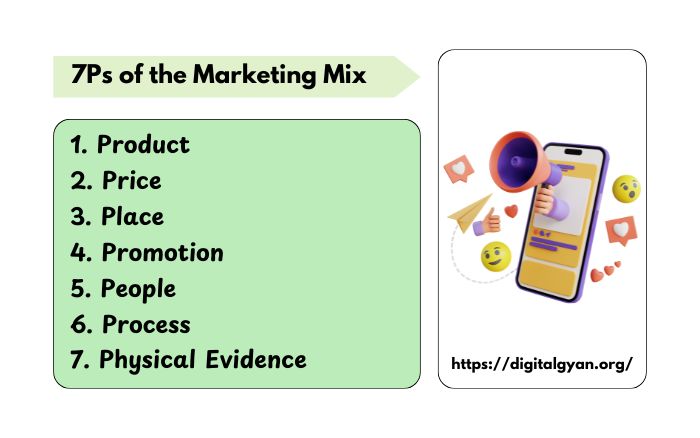
Originally, the concept started with 4Ps—Product, Price, Place, and Promotion, but as markets evolved, three additional components—People, Process, and Physical Evidence—were introduced to address the complexities of modern business.
1. Product
It is the services or goods produced by the company to meet the demands of the consumers. It encompasses design, quality, attributes, brands, and variations. The perfect product should be able to meet a specific need or solve a problem that the target market has. Understanding the life cycle of the given product, such as introduction, growth, maturity, and decline, plays a critical role in marketing.
An effective product strategy means understanding customer challenges first. Organisations need to clearly outline the problems they solve with a product, as well as how they solve them in a manner that is more efficient than the competition. The timely improvement of features, designs, as well as the obsolescence of old versions is essential in product lifecycle management. Why do some poor products receive so many marketing resources, only to fail in the market? It is because they fail to meet the changing dynamics of customer needs.
2. Price
Price is what consumers pay for a good or service. It is an indication of perceived value, competition, cost of production, and general market demand. Pricing methods can differ, such as penetration pricing to win customers or premium pricing to brand a product as high-quality. The correct price is crucial, as it has a direct impact on sales volume and profitability.
Studies by McKinsey indicate that a 1% improvement in pricing can increase operating profits by up to 8%, making price one of the most powerful levers in the marketing mix.
3. Place
Place is the 3rd P in the 7Ps of the marketing mix. Place, or distribution, is about making the product accessible to customers at the correct location and time. It encompasses choosing the right distribution channels, inventory management, and effective logistics. The aim is to make it easy for customers to access the product, either through physical outlets, online, or both.
4. Promotion
The promotion covers the different approaches used to deliver messages to the target market concerning the product or service. Promotion involves advertising, public relations, sales promotion, and personal selling. Good promotion creates awareness, stimulates interest, and convinces prospective buyers to buy. Today, promotional strategy also focuses mainly on social media marketing and content marketing.
Effective promotion is a function of the message’s clarity and the promotional channels’ relevance. Organisations should synchronise their promotional strategies to favour consumer preferences, irrespective of the platform—social media platforms, search engines, or other offline channels. Promotion helps to accentuate the existing inherent value of the business entity in terms of the product, price, and place strategies.
5. People
People encompass all individuals participating in the provision of a service or product, from staff to clients. Personnel are an essential component in service industries as they have a direct influence on customers’ satisfaction and impressions. Educating staff to be informative and friendly guarantees a satisfactory customer experience, promoting loyalty and favourable word-of-mouth.
6. Process
Process refers to the systems and procedures that serve in the delivery of a product or service to the customer. This involves elements such as the delivery efficiency of services, standard operating procedure, and the entire customer journey. Efficient processes ensure continuity, are cheaper, and improve the satisfaction of customers by offering a smooth experience.
Process management has been revolutionised with automation and technology. Organisations that improve customer processes through digital transformation experience a positive outcome of up to 20% increased customer satisfaction, as stated by Deloitte. Efficiency is not expected to be compromised in terms of flexibility. A certain level of personalisation is essential for customer processes.
7. Physical Evidence
Physical evidence refers to the physical items that affirm the quality and existence of a product or service. It involves the physical setting where the service is performed, packaging, branding materials, and even digital presence. A well-presented website or brochure that appears professional, for example, can impact perceptions and increase credibility.
According to an article from Harvard Business Review, the first impressions about a physical environment occur within seconds, and a designed environment, interface, or physical setting instils confidence and breeds consistency. Immediate reinforcement through physical elements should correspond to and align with values and expectations. When images and experiences match, trust escalates.
Also Read: What is the 4S of Web Marketing Mix?
Implementing the 7Ps in Marketing Strategy
Implementing the 7Ps in a marketing strategy needs a thorough knowledge of all the elements and how they relate to one another. Here is how companies can implement this model:
Product Development: The business should conduct market research to understand customer needs and preferences, leading to the creation of products that offer unique value propositions.
Pricing Strategy: Next, the marketing team of the company should analyse competitors and assess the perceived value to set a price point that balances profitability with customer satisfaction.
Distribution Channels: The firm should choose channels that align with where its target customers are most likely to shop, ensuring product availability and convenience.
Promotional Activities: The company needs to develop integrated marketing campaigns that utilise various platforms to reach and engage the target audience effectively.
Staff Training: Companies need to invest in training programs to ensure employees represent the brand well and deliver exceptional customer service.
Process Optimisation: Regularly review and refine processes to enhance efficiency, reduce costs, and improve the customer experience.
Enhancing Physical Evidence: Maintain a consistent and professional brand image across all physical and digital touchpoints to build trust and recognition.
Also Read: 7 Marketing Tips for Restaurant Startups
Conclusion
The 7Ps of the marketing mix give a comprehensive platform for companies to design successful marketing strategies. Through careful examination and optimisation of every element—Product, Price, Place, Promotion, People, Process, and Physical Evidence—businesses are able to better serve customers, stand out in the market relative to competitors, and attain lasting success in the market.
A considerate use of the 7Ps challenges companies to consider viewing marketing as a system, instead of just a promotional function. When product, pricing, accessibility, communication, people, process, and physical evidence are in harmony, it is possible to provide a meaningful experience.