Cisco certification is a professional credential that validates technical knowledge and skills in networking and related IT technologies. Among Cisco’s best-known credentials is the CCNA, which has changed significantly over the years. One common source of confusion is the difference between the older CCNA 200-125 exam and the newer 200-301 exam.
The 200-125 exam belonged to Cisco’s previous CCNA structure, while 200-301 became the single exam required for the current CCNA certification. The newer exam also broadened its coverage to include security fundamentals, automation and programmability alongside core networking topics.
How to Obtain CISCO Certification?
This certification can be obtained by passing the Cisco CCNA exam or by taking and passing two additional exams: ICDN1 and ICND2. If you pass your exam(s), your CCNA certification will be valid for three years before you must recertify.
If you want to work in networking, it’s customary for companies to require that you have a CCNA certification before you can be considered for a position (Cisco Certification Reviews).
There are four levels of Cisco certification:
Associate: Associate certifications are entry-level certifications that provide a foundation in Cisco networking technologies.
Professional: Professional certifications are intermediate-level certifications that demonstrate expertise in a specific Cisco networking technology or solution.
Expert: Expert certifications are advanced-level certifications that validate a candidate’s mastery of Cisco networking technologies.
Architect: Architect certifications are the most prestigious Cisco certifications, and they are awarded to candidates who have demonstrated exceptional expertise in Cisco networking technologies and solutions.
CISCO 200-125 Exam
The Cisco Certified Network Associate (CCNA) Routing and Switching composite exam (200-125) used to be a 90-minute, 60-70 question evaluation connected with the Cisco Certified Network Associate (CCNA) Routing and Switching certification.
This exam assessed a candidate’s knowledge and skills in the following areas: network fundamentals, local area network (LAN) switching technologies, IPv4 and IPv6 routeing technologies, wide area network (WAN) technologies, and infrastructure services, infrastructure security, and infrastructure management.
Cisco certification programme has undergone significant changes as of Feb. 24, 2020. There would be fewer CCNA examinations and certifications available. There would be only one complete examination available. CISCO 200-125 exam has been discontinued and replaced by the most recent exam code CCNA 200-301, and so the full title is Implementing and Administering Cisco Networking Technologies. You can find out more here.
CCNA 200-301 content
CCNA 200-301 exam is designed for networking professionals to test their skills in network designing, security, quality of service, Voice over IP, and VPN. Before taking this exam you should possess the basic knowledge of networking and routing protocols to pass this CCNA exam.
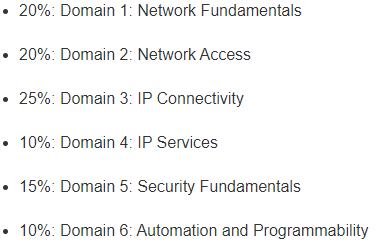
Click here to find out more about CCNA 200-301 exam.
Candidates are expected to have a working knowledge of Cisco networking products and solutions. They should also be able to demonstrate their ability to configure and troubleshoot Cisco networking devices.
Difference between CCNA 200-125 vs CCNA 200-301 Exams
| Feature | CCNA 200-125 | CCNA 200-301 |
|---|---|---|
| Status | Retired | Current CCNA exam |
| Exam structure | Two-exam path was associated with the old CCNA | One required exam |
| Exam code | 200-125 | 200-301 |
| Certification | Old CCNA pathway | Current CCNA |
| Main focus | Routing, switching and traditional networking topics | Broader networking, security, automation and programmability |
| Exam duration | 90 minutes | 120 minutes |
| Current availability | No | Yes |
| Prerequisites | None | None |
The crucial point is that 200-125 and 200-301 are not simply two versions of the same exam. Cisco changed the certification structure when it introduced the 200-301 CCNA. The current 200-301 exam covers network fundamentals, network access, IP connectivity, IP services, security fundamentals, and automation and programmability.
Why Did Cisco Replace CCNA 200-125?
Cisco changed the CCNA structure to create a broader certification that reflects modern networking roles.
The current 200-301 exam covers areas including:
- network fundamentals
- network access
- IP connectivity
- IP services
- security fundamentals
- automation and programmability
The 200-301 v1.1 update also incorporated areas such as AI and machine learning in network operations, along with changes to automation and management topics.
This is a much more useful explanation than simply saying that “200-301 is newer.Cisco changed the CCNA structure to create a broader certification that reflects modern networking roles.
The current 200-301 exam covers areas including:
- network fundamentals
- network access
- IP connectivity
- IP services
- security fundamentals
- automation and programmability
The 200-301 v1.1 update also incorporated areas such as AI and machine learning in network operations, along with changes to automation and management topics.
Conclusion
Cisco certification provides a recognised way to demonstrate networking and IT skills, while the CCNA remains one of Cisco’s main entry points into professional networking. The difference between CCNA 200-125 and 200-301 is significant because they belong to different certification structures. The 200-125 exam is part of Cisco’s retired CCNA pathway, whereas 200-301 is the current CCNA exam and covers a broader mix of networking, security, automation and programmability.
For someone preparing for the certification today, there is no reason to study the old 200-125 exam. The current 200-301 remains available through February 2, 2027, after which Cisco plans to introduce CCNA v2.0.