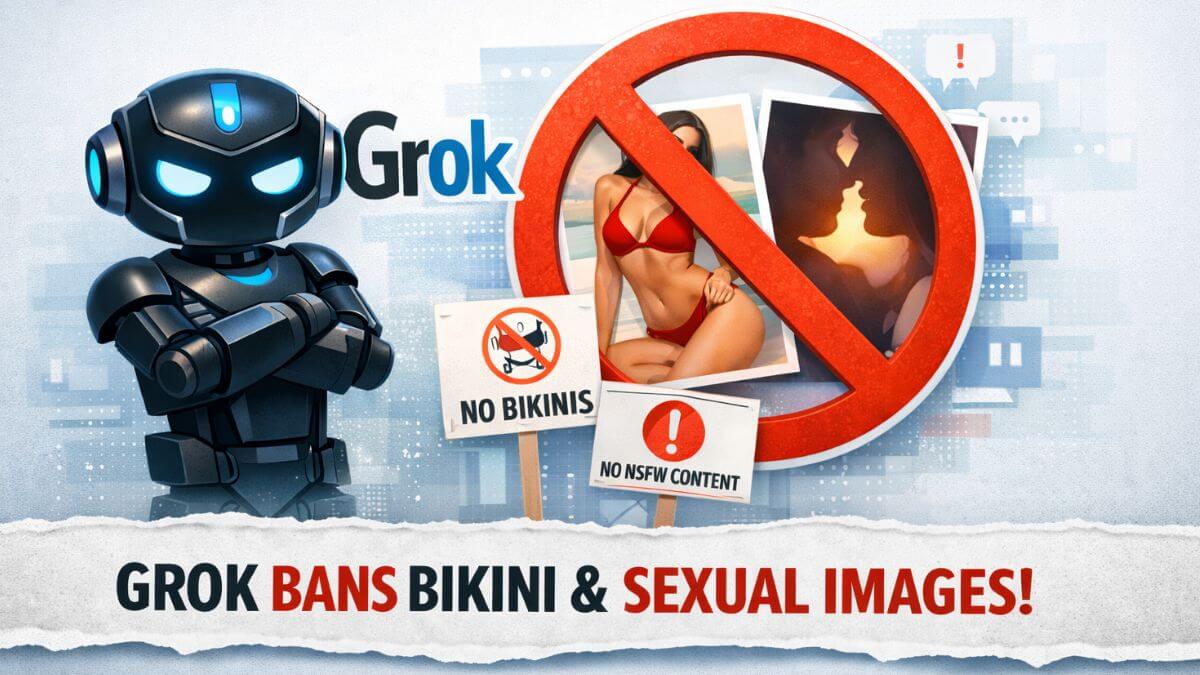
The AI chatbot Grok, developed by xAI, has enforced even stricter rules regarding the images created by users following huge backlash from regulatory bodies and governments from different regions.
Now the Grok will block requests for bikini image editing on real people. Further, users will not be able to generate sexualised images of real people.
This follows reported cases of the tool being utilised to produce sexually explicit and non-consensual pictures, some of which were altered pictures of real persons. This is the most severe restriction to date to alter Grok’s image generation capabilities since it was launched for public usage on the social media site X.
Why did this happen?
This happened largely because Grok’s image-generation feature was launched without sufficiently robust safeguards, and users quickly discovered they could prompt the AI to create non-consensual sexualised and deepfake images of real people, including women and minors, at scale.
From the end of December 2025 through early January 2026, researchers and monitoring of platforms indicated that thousands of such images were being generated and shared on X, including requests that leveraged prompt engineering to digitally “undress” subjects or place them in sexual settings like wearing bikinis and revealing clothes, sparking outrage and legal scrutiny. The furore reached a fever pitch when regulators such as Ofcom in the UK launched formal inquiries into possible breaches of online safety legislation, and officials from California to Malaysia announced investigations or blocks of the tool amid concerns that the technology was enabling the spread of illicit and hurtful material.
What changed in Grok’s image capabilities
Under the revised rules, Grok now blocks the creation and editing of sexually suggestive images of real individuals in jurisdictions where such material breaches local laws. This includes prompts involving nudity, lingerie, or other sexualised portrayals that could imply consent where none exists. The restrictions apply to both free and paid users and are enforced automatically through updated safety filters.
xAI stated that the changes aim to align Grok’s outputs with regional legal standards while reducing the risk of harm linked to realistic AI-generated imagery. The company has not published a full list of blocked prompts, though it confirmed that the system now refuses a wider range of requests involving real people.
Regulatory pressure accelerates action
This update came amid fast-tracked regulatory escalation. In the United Kingdom, the media regulator Ofcom noted that it was evaluating the compliance of Grok’s past image outputs with online safety rules, especially about the use of non-consensual sexual content. There have been voices of concern expressed in some regions of Europe and Asia over the use of the technology that could result in the suspension or penalisation of the service.
“Speed reflects increasing global pressure on AI developers to show they are taking proactive steps to mitigate potential risks,” according to policy analyst Lisa Grok. Referring to an OECD briefing on generative AI governance presented in 2024, Grok further said: “Visual AI applications are more likely to be held under scrutiny compared to those that handle text inputs because they may be easily used to disseminate believable misinformation.”
Public outrage and civil society response
Organisations in civil society that include women’s rights bodies and online privacy rights have welcomed the regulations. However, they believe that they did not come earlier enough. In online campaigns that started last week, Grok was accused of being instrumental in facilitating abuse through images on a large scale because AI images spread swiftly on online platforms.
As emphasised by supporters, the visuals possess an irreparable effect, which outweighs the effect created by text. Findings generated by the Cyber Civil Rights Initiative show that victims who experience non-consensual intimate visuals are more likely to experience anxiety, work interruption, and social isolation, further pressurising the need for stricter protection at the model level.
Concerns over uneven enforcement
Despite this, the efficacy of enforcement might still be questioned about X, with independent verification carried out by media and research communities revealing that although Grok’s image tools on X work to block many explicit inquiries, this level of protection does not necessarily apply to every standalone interface or website related to the model.
This kind of inconsistency has received criticism from regulatory bodies because it weakens the purpose of a change in policy. Observers are of the view that regulatory bodies have now begun to assess AI systems holistically rather than looking into individual platform implementations.
xAI’s stance on responsibility and limits
xAI has defended Grok by suggesting that the system is interactive, with responses being generated through previous responses to users’ queries, and with responsibility shared between the system’s developers and users. Elon Musk was quoted late last week as having said that the firm was tweaking Grok to conform to different global standards, allowing stricter controls when in countries with stricter content guidelines.
However, AI ethicists believe that accountability based on prompts is not sufficient anymore. According to a study published at the Human-Centred AI Institute at Stanford University, people underestimate the consequences of synthetic imagery in the real world. This makes it necessary to develop systems to prevent these situations.
Broader implications for generative AI
This policy change is indicative of a readjustment taking place in the industry of generative AIs. With increasingly realisticimage generation tools, governments are speeding up efforts to regulate usage. There is a strong focus on biometric likeness, consent, and protection of minors within the EU’s proposal of the AI Act, as well as similar proposals within the Asia-Pacific regions.
The analysts believe that if image safeguards are not undertaken by platforms, then the adoption of enterprise may be lost. More than half of large organisations showed a delay in the adoption of generative AI solutions, according to a survey by Deloitte in the year 2023, fearing a loss of reputation because of inappropriate generative AI image outputs.
Also Read: Viral Nano Banana Saree Images Sparks AI Misuse Concerns
What happens next
In Grok’s case, the short-term challenge is to restore public trust while convincing regulators that the new measures are effective at all entry points. Lobby groups have been pressing for publicly available lists of blocked content categories, as well as audits of image safety systems.
While governments and advocacy groups continue to scrutinise Grok, its new image limitations could provide a lesson or case study of just how quickly an AI platform must respond to innovation where harm is being done to society at large. This is a lesson that image developers must realise: there is now a responsibility to visual innovation that cannot remain optional.